


The Recession’s Whipping Boy
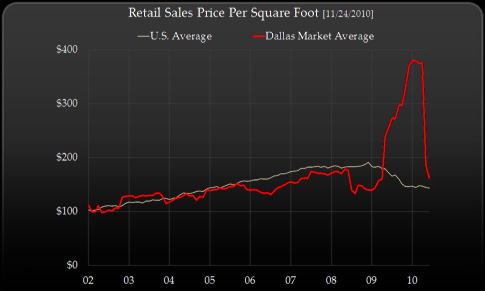
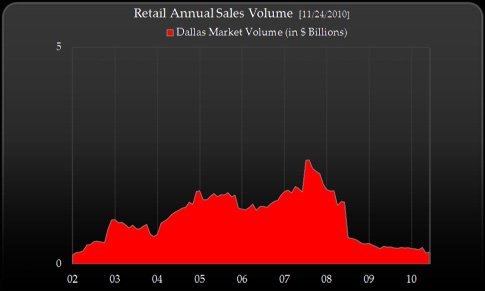
Even through the strength of a growing population and consumer friendly work force, the Dallas-Fort Worth retail sector have been taking the brunt of the economic pain. Consumer spending, which represents two-thirds of the economy, had the highest reduction in 28 years during 2009. The virtual collapse of the credit markets in 2007 pushed newly unqualified homeowners into alternative housing forcing a sharp slowdown in residential construction. Retail Cap Rates in the third quarter of 2009 represented nine buildings and 400,755 square feet of space at an average price per square foot of $106.86. This compares to a total of six transactions sold in the second quarter of 2009 for $29,700,000 on 321,330 square feet of space at $92.43 per square foot. Total sales through 2009 involved $94,301,000 at a price of $96.84 per square fot on 23 retail sales. This compares to $271,145,212 of retail property sold at $107.82 on 47 retail sales in 2008 for the same 9 month period. Retail absorption in the fourth quarter was 923,323 compared to a third quarter absorption of 646,409 square feet and 360,644 square feet in the 2nd quarter and 486,752 square feet in first quarter in 2009.

The residential equity-line had been the ultimate consumer credit card, and this has given way to massive credit card debt escalation. With consumers counting their pennies, retail construction halted leaving expansion plans on hold. Consumers have been hording their discretionary capital and we have seen a significant amount of increases in personal savings accounts. In fact savings expressed as a percent of individual dispoable income has increased from a low of (.7%) in the second quarter of 2005 to 6.9% in the second quarter of 2009.
The Dallas-Fort Worth retail sector had a fourth quarter vacancy factor of 9.3% decreasing from a second quarter vacany of 9.4% and a 9.3% third quarter vacancy. Quoted rental rates increased to $14.42 in the fourth quarter of 2009 from $14.46 in the third quarer of 2009. These minor decreases reflect the strength of the affluent DFW market which has a considerable amount of “consumptive shoppers,” especially in laregly recession-averse locations like Uptown, Park Cities, and the booming Frisco and North Dallas submarkets.

Shopping Center owners will face dramatic challenges as more national closings are announced. Significant retailers that are either closing or constricting include: Circuit City (all 567), KB Toys (all 461), Ritz Camera (all 400), Starbucks (300), and many, many more. Most shopping centers will be trying to “dig in” and survive 2009 and find solutions for lost foot traffic from anchor tenant closings.
![]()
Stay Alive, and Prepare for the Vacancy Bombs
Owners are in the unfortunate position of losing their most precious commodity as anchor tenants walk away from tenant leases leaving renewals and expansions in question. Tenants feeling the pinch will continue negotiating rent concessions with property owners asking for reduced rental rates, tenant improvement dollars, and specific periods of free rent and rent forebearance of 6-12 months.
Property owners are facing the challenges of non-performing tenants, new lender and tenant credit requirements, and property value erosion. Owners are also working with lease renewal signings dealing with retailers who are simply trying to weather the current economic storm. Property owners should be seeking seasoned real property professionals to assist them balance rental rate achievement with the increasing possibility of high vacancies and operating deficiencies.

In summary, retail construction has slowed, as both tenants and owners attempt to attract and earn income –leaving expansion on hold. Tenant retention and creative lease structuring will separate seasoned property ownership and professionals from the novices and this will be the key for preserving property market value.

![]()
Sales Buildings Quarter Volume Price/SF
Retail Property Sales 9 (Q3-2009) $ 42,826,000 $106.86
Retail Property Sales 6 (Q2-2009) $ 29,700,000 -
Retail Property Sales 23 (2009) $ 94,301,000 $ 96.84
Retail Property Sales 47 (2008) $ 271,145,212 $107.82
Class Buildings Inventory SF Rate/SF Vacancy
General Retail 12,541 132,116,047 $13.44 5.7%
Malls 43 33,887,077 $24.37 7.8%
Power Center 68 26,150,545 $18.70 7.9%
Shopping Center 3,410 152,874,551 $13.96 13.96%
Specialty Center 20 1,953,096 $28.70 5.3%
Total Retail 18,688 346,981,216 $14.42 9.3%
2009 2nd Qtr. Deliveries
977,934 [ 32 Buildings ]
2009 1st Qtr. Deliveries
1,941,601 [ 45 Buildings ]
2009 Net Absorption 166,491 [ 2nd Quarter ]
2009 Net Absorption 518,454 [ 1st Quarter ]
2008 Net Absorption 2,229,408 [ 4th Quarter ]
2008 Net Absorption 1,697,695 [ 3rd Quarter ]
2008 Net Absorption 2,519,631 [ 2nd Quarter ]
2008 Net Absorption 2,204.904 [ 1st Quarter ]
Cap Rate Breakdowns 2008 2009
Average Cap Rate 8.83% 8.23%
---------------------------------------------------------------------------------------------------------------
Revised DFW Job Growth for 2009: (107,300)
---------------------------------------------------------------------------------------------------------------
![]()
Cap Rate Explosion = Value Erosion
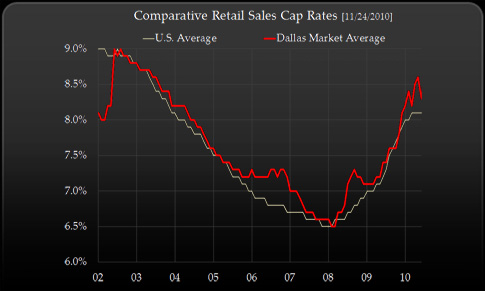
2008 and 2009 Cap Rates were reflective of prior historical marketplace cap rates where cap rates approached 10%. Why is this occurring? Oftentimes cap rates are intrinsically tied to cost of funds i.e. loan constants and a positive arbitrage spread on the underlying debt portion of the purchae amount. . As shorter amortization periods and higher spreads translated into the loan market, increased cap rates likewise escallated.
Wall Street’s CMBS pipeline filtered massive long-term debt into the commercial real estate market resulting in significant cap rate compression and asset value appreciation. In today’s current market place long term debt is very scarce, and CBMS financing nearly non-existent. Needs for increasing equity and capital liquidity are growing, triggering a cap rate explosion.
Substantive property value erosion is now occurring . Decisive action is increasingly important today. Owners must contemplate the merit of jumping out ahead of a “falling knife” and transacting a property sale or evaluate the “risk-reward” dynamics of holding onto the asset through the next investment cycle. The following graphic depicts this cap rate explosion phenomenon:
Historic Distribution of Cap Rates From 2002 Through 2008
Cap Rate/Year 2008 2007 2006 2005 2004 2003 2002
5% or Less 13.4% 18.28% 15.04% 14.94% 6.03% 1.99% 0.87%
6% or 7% 57.99% 63.39% 61.42% 52.91% 43.18% 27.87% 11.49%
8% or 9% 24.86% 16.47% 20.92% 27.69% 40.94% 52.88% 53.28%
10% or more 3.75% 1.86% 2.62% 4.46% 9.85% 17.27% 34.35%
Data Source: Real Capital Analytics
![]()
The New Rules of Money - Rebalancing the Equity Equation

Investors are being forced to reevaluate the asset holding cost of their portfolio assets. With cap rates exploding and property values eroding, the adjusted requisite equity contribution to secure new financing is staggering. The above example contemplates an original $20,000,000 asset and a $4,000,000 equity position.
As the loan underwriters require a 65% loan to value structure, the additional equity requirement is pictured as the cap rates increase at 100 Basis Point Increases from 6.5%-9.5%. The Original Equity of $4,000,000 requires an additional capital requirement of $7,894,737 if cap rates increase to 9.5%.
More importantly the asset value decreases from its orignal $20,000,000 to $11,578,947. All investors who have refinancing requirements in the next five to seven years must evaluate whether or not such additional capital injections are appropriate as they try to optimize their portfolio holdings.
![]()